KULT Drive · Updated
Bentley Blower: the famous supercharger and the debate over power
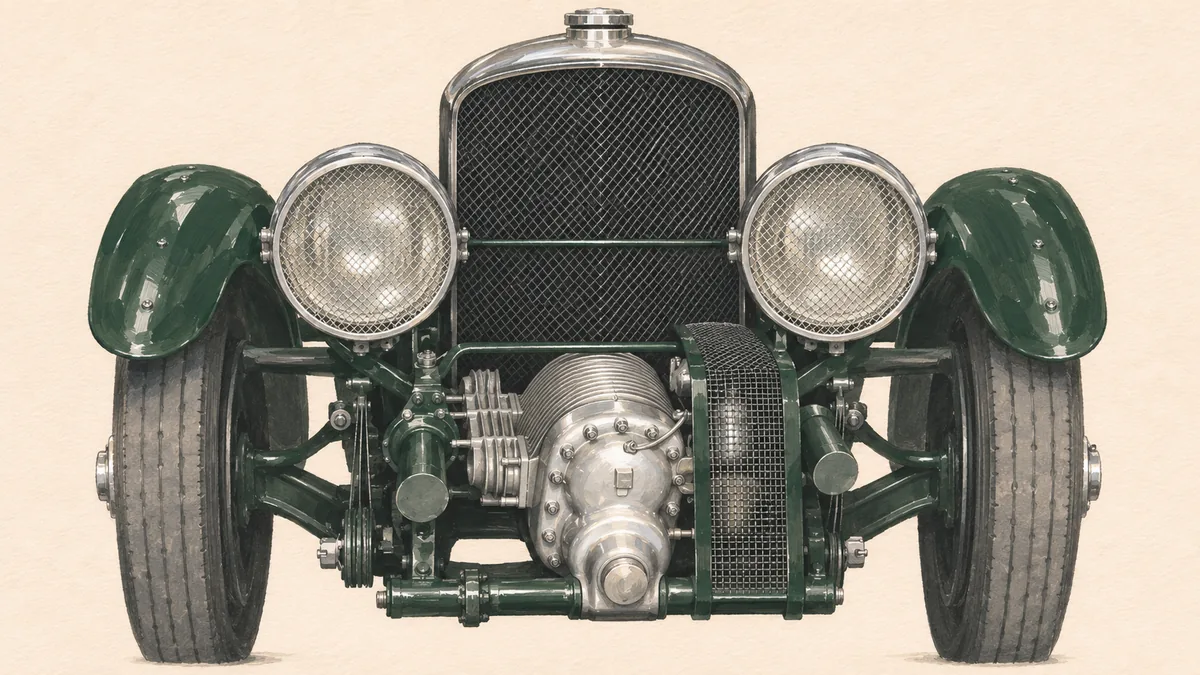
The Bentley Blower was a bold supercharged development of the 4½ Litre. Its story is a debate between engineering approaches, not simply a string of wins: the famous Blower must not be confused with the Bentley that won Le Mans in 1929 and 1930.
Power can be achieved in different ways
Two approaches collided in Bentley’s history in the late 1920s. Increasing engine displacement and adding a supercharger offered different routes to greater output. Tim Birkin supported the supercharged option, while Dorothy Paget helped fund the project. It used an Amherst Villiers supercharger. Bentley history.
The result was a car recognisable by the large mechanical device ahead of its radiator. On the Blower, an engineering component became part of the visual identity, rather than being hidden behind smooth bodywork.
An important correction to the racing legend
Bentley’s official chronology records Birkin’s second place at the 1930 French Grand Prix. Bentley’s Le Mans victories in 1929 and 1930, however, belong to the Speed Six. The models must not be conflated for a more dramatic story. Bentley: the brand’s history.
That distinction does not make the Blower less interesting. Instead, it frees the story from having to prove the car’s importance exclusively through a record of wins. A design’s influence and image can sometimes extend beyond its sporting results.
Why the Blower became recognisable
The large open body, long bonnet and forward-mounted supercharger create a very physical image of speed. There is no sense that the technical work is happening somewhere behind a screen. Viewers almost immediately understand that this is a machine requiring mechanical interaction.
This is an editorial interpretation of design, not a claim about ease of control or safety. Historical racing cars cannot be placed in a modern road-use scenario without understanding their limitations.
How the past is studied today
For the Blower Continuation project, Bentley specialists dismantled an original 1929 car, catalogued and scanned its components, then restored it. The process illustrates the difference between copying an appearance and investigating a design. Bentley Blower Continuation.
A replica or continuation series does not automatically become an original 1920s car. Every vehicle’s manufacturing date and provenance should be honestly described.
The Blower story is compelling because it preserves an engineering disagreement. It shows that automotive development does not always follow one obviously correct path. Sometimes disputed, risky decisions create an image that outlives its era, even when the racing record is more complicated than the legend.
Questions and answers
Did the Blower win Le Mans in 1929 and 1930?
Those victories belong to the Bentley Speed Six. The Blower’s history should be considered separately.
Is a Continuation an original 1929 car?
No. It is a modern reproduction based on a historical example; provenance and manufacturing date should be stated honestly.