KULT Drive · Updated
Benz Patent-Motorwagen: the car began without a bonnet or steering wheel
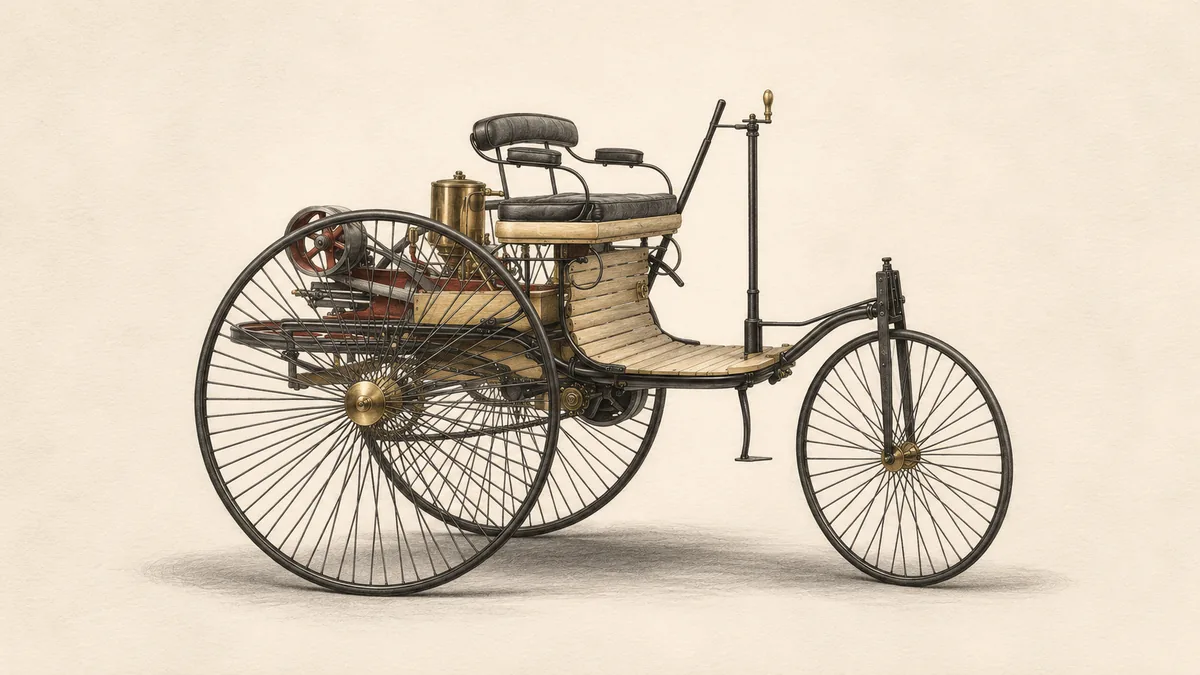
The Benz Patent-Motorwagen is a key starting point in petrol-car history. Its importance goes beyond the 1886 patent: it showed that engine and chassis could be designed as a vehicle in their own right, rather than a modified carriage.
A car before the familiar image of a car
Imagine a car without the usual four wheels, enclosed body or large steering wheel. This object, unusual to modern eyes, begins the story of Carl Benz’s Patent-Motorwagen. The application for patent No. 37435 was filed on 29 January 1886. Its three wheels and internal-combustion engine were integrated into a purpose-designed vehicle. Mercedes-Benz archive.
It is important not to turn this history into an argument about the sole inventor of all self-propelled transport. Steam-powered and other experimental vehicles existed earlier. Benz’s project matters within a particular line of petrol-car development, not because it erases every predecessor.
Why three wheels are more than a curiosity
To a modern driver, this layout looks like a compromise. But the early car had to solve several problems now taken for granted: propulsion, steering, cooling, power transmission and stability. Treating it as a smaller modern car is misleading.
It is more interesting to see an experimental system. Every component had to work with the others, rather than merely demonstrate a principle in a workshop. This is how a technical idea gradually became a usable object.
The journey that made the invention understandable
In 1888, Bertha Benz and her sons made a long-distance journey in an improved vehicle. The brand’s history treats this episode as important evidence of the new transport’s practical usefulness. Carl Benz’s biography.
The story means more than an exciting road adventure. Successful use answers a question a patent cannot: can an ordinary person actually get somewhere? Trust in new technology comes not just from specifications, but from an understandable use case.
What feels contemporary in this story
Today’s buyers also ask about more than power: charging, servicing, reliability and convenience matter. This is an editorial parallel, not a claim that the technologies are identical. An invention becomes transport when workable everyday practices develop around it.
The Patent-Motorwagen therefore deserves to be shown as more than an amusing museum cart. It reminds us that familiar solutions were once open engineering questions, and that a good car results from the whole system working together, rather than one outstanding component.
Questions and answers
Was this history’s first self-propelled vehicle?
No. Other self-propelled designs existed earlier. The Patent-Motorwagen is associated primarily with the birth of the petrol car in its modern historical lineage.
Why does Bertha Benz’s journey matter?
It demonstrated that the vehicle could be used practically over long distances and helped make the invention understandable beyond the workshop.