KULT Drive · Updated
Bugatti Type 35: when a racing car became an engineering drawing
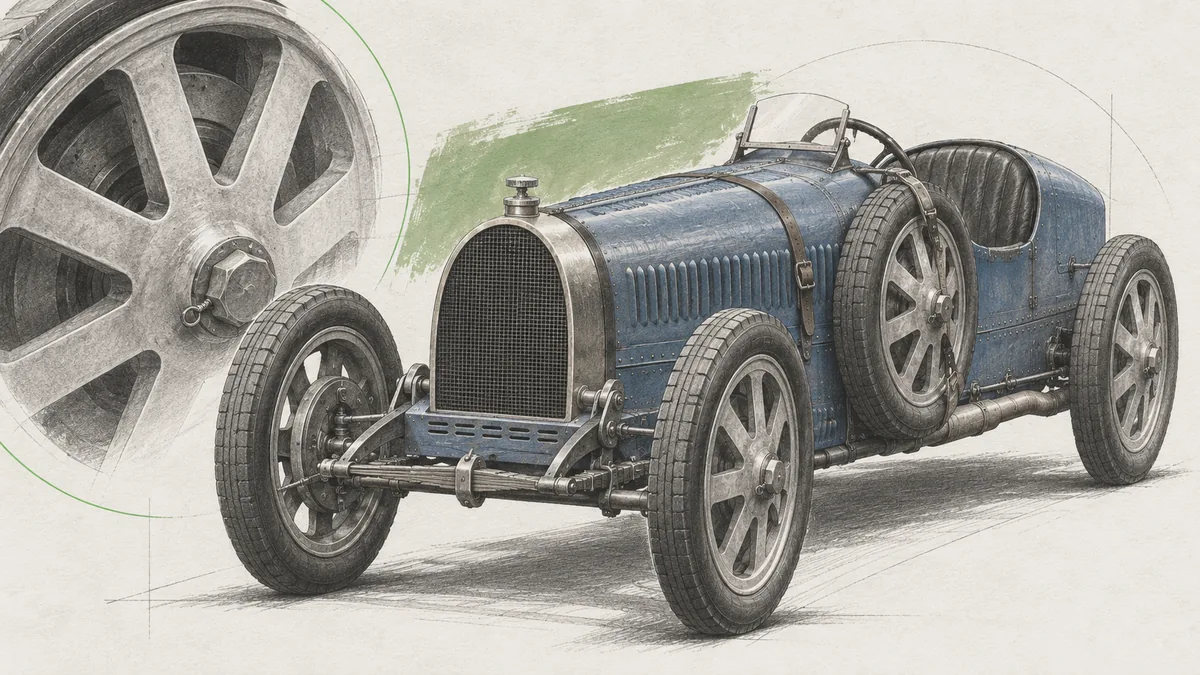
The Bugatti Type 35 combined a recognisable shape with serious racing development. Its historical value lies in the coherent design and the family’s racing career, not just a beautiful blue body.
A car recognisable without its badge
The Type 35’s exposed wheels, narrow body and distinctive radiator shape create an almost graphic silhouette. Much more of its machinery is visible than on a modern car. Design and construction are perceived together, so its story cannot be divided into independent chapters on “beauty” and “technology”.
The Type 35 made its debut at the French Grand Prix in Lyon on 3 August 1924. Bugatti regards that start as the beginning of one of its most important stories. Account of the first race.
Engineering on a compact scale
The model featured a straight-eight engine and distinctive alloy wheels. The manufacturer emphasises attention to weight, balance and precision of components. The family subsequently evolved, so specifications should refer to a particular version, rather than combine maximum figures from different cars into one portrait. Bugatti on the Type 35’s design and centenary.
That is what makes it interesting as an engineering story: better results are not simply a matter of fitting a more powerful engine. Weight, response, cooling and components working together also determine how a car behaves.
A reputation built through repeated competition
The Type 35 family is associated with many racing successes. Bugatti’s accounts highlight Targa Florio victories in 1925–1929. The brand’s aggregate victory figures should be understood as its historical count, not the result of a modern independent statistical database.
What matters more to readers is the length of its sporting life and the design’s development. One successful start can make a headline; repeatable results build a reputation.
Why the Type 35 need not be compared with a modern hypercar
Sharing the Bugatti name does not make cars of different eras direct competitors. Their purposes, rules and approaches to safety differ. A historical racing car tells us about its own time; it should not be judged only by its speed relative to a modern road car.
A strong Type 35 story can be built around visible engineering choices: wheels, suspension, driving position, engine and body. This helps viewers understand why the car became recognisable without invoking a myth of unattainable perfection.
The Type 35 is interesting precisely as a combination of an idea and sustained work on it. Behind the famous shape lies not one beautiful sketch, but a sequence of sporting challenges and technical responses.
Questions and answers
Did all Type 35s have the same engine and power?
No. The family evolved, so specifications must be tied to a particular version and year.
When did its racing debut take place?
Bugatti gives the French Grand Prix in Lyon on 3 August 1924.