KULT Drive · Updated
Citroën DS: the car that looked and worked differently
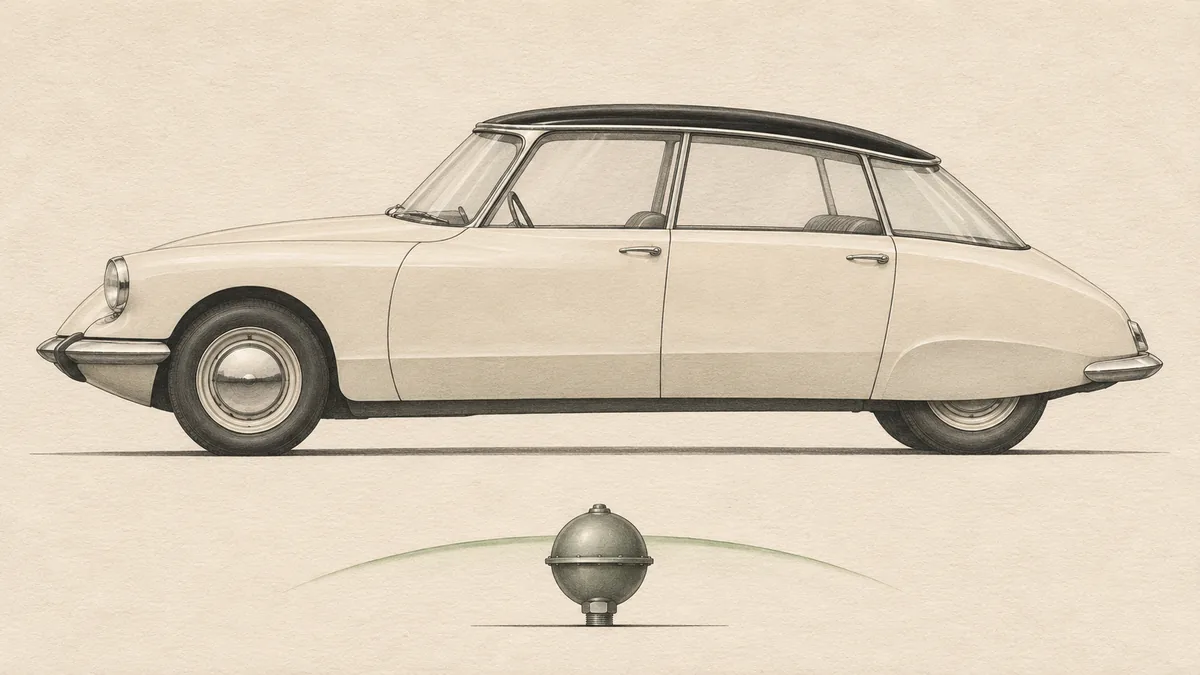
The Citroën DS became a striking example of a car whose shape and technical concept both broke with convention. Its hydropneumatic suspension made comfort a full engineering discipline, rather than just a matter of soft seats.
A debut hard to mistake for an ordinary update
The DS 19 was unveiled at the Paris Motor Show on 6 October 1955. André Lefèbvre, Paul Magès and Flaminio Bertoni played important roles in its development: engineering layout, hydraulic system and body design came together in one unusual project. The history of DS.
The car stood out for its elongated, streamlined silhouette and unfamiliar proportions. But treating it only as a sculpture misses the point: beneath its appearance lay an equally unconventional technical idea.
Comfort as a system
Hydropneumatic suspension used the interaction of gas and fluid to maintain the body's position and respond differently to road irregularities. Citroën regards this technology as an important stage in its history of comfort. Citroën on suspension development.
It helps to separate the principle from the advertising impression that “the car floats”. Ride quality depends not on one magical component, but on a coordinated system, the condition of its parts and the particular circumstances.
The DS evolved rather than remaining frozen in 1955
The family gained different versions, with engineering and styling evolving over time. The famous swivelling headlights arrived with the 1967 update; the official chronology lists them as standard on Prestige, Pallas and Cabriolet versions. They were not a feature of every DS from the start of production. DS chronology.
This matters in automotive history: photographs from different years are often mixed together, creating an imaginary car with the best features of every generation. A real example always has a date and a specification.
Why bold engineering needs the right maintenance
An unusual system is not automatically unreliable, but it requires an understanding of its design and the correct procedures. For a historic car, condition and the quality of previous work often matter more than a model's abstract reputation.
This is a practical conclusion, not a ready-made DS repair guide. Hydraulic-system maintenance cannot be replaced by generic advice for conventional suspension or by choosing fluid solely by its colour.
Why tell the DS story now
Modern cars are once again competing on comfort technology, body control and electronic settings. The DS reminds us that engineering ambition existed long before the large central screen.
Its story lends itself especially well to visual explanation: show a conventional spring, then the principle of hydropneumatics, before returning to the car's silhouette. Viewers will see not just a beautiful French classic, but an attempt to rethink the everyday journey as a whole.
Questions and answers
Did every Citroën DS have swivelling headlights?
No. This feature belongs to a later update, not to every car built since 1955.
Is hydropneumatics just a very soft spring?
No. It is a system using gas, fluid and hydraulic control; its operation and maintenance differ from conventional spring suspension.