KULT Drive · Updated
The classic Mini: a small car with a big engineering question
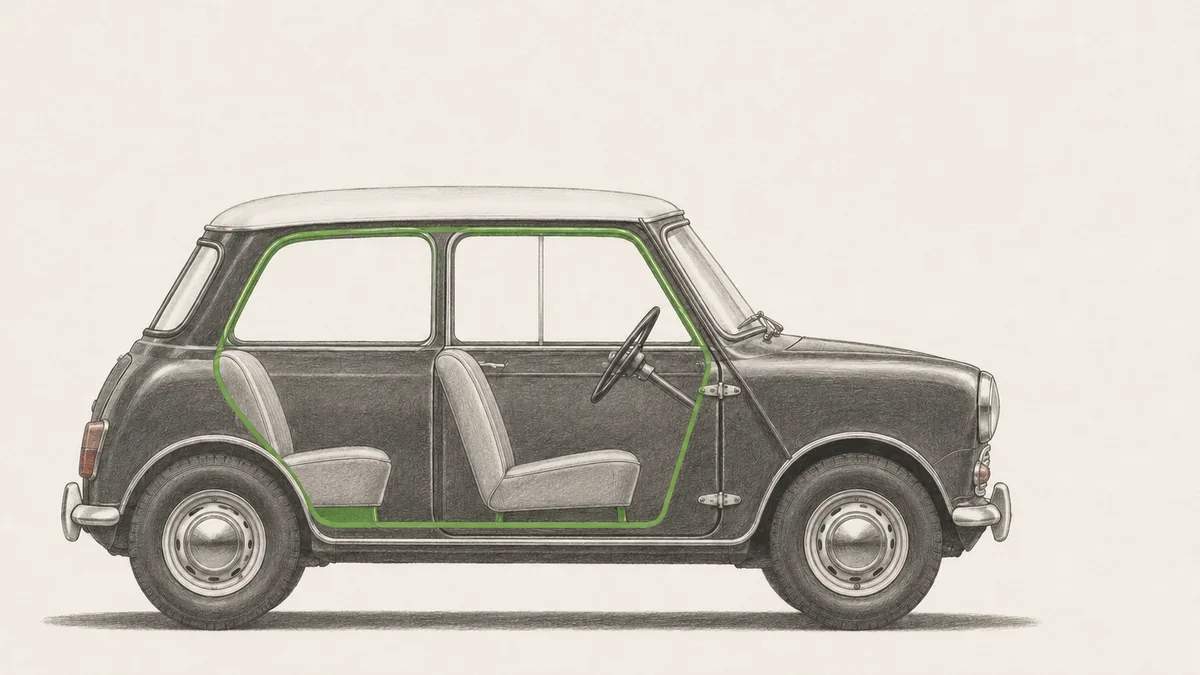
The original Mini showed how strongly layout affects usable space. Its transverse engine and front-wheel drive helped create a compact car whose significance far exceeded its external dimensions.
Redistributing space, not shrinking a large car
Designed by Alec Issigonis, the Mini arrived in 1959 under the Morris and Austin brands. The BMW Group Classic archive specifically describes the Morris Mini-Minor with a transverse front engine and front-wheel drive. Mini-Minor archive.
The main task was not to shorten a conventional car at any cost. It was to divide a limited volume sensibly between passengers and machinery. That is why the Mini's story is, above all, about packaging.
When a small engineering idea changes a product's character
Moving the engine relative to the axles and cabin affects usable space, proportions and how a car is used. In the Mini, the technical solution became the basis of a recognisable identity, not a hidden feature under the bonnet.
MINI's official history links the car's emergence to post-war economy and fuel constraints. MINI on 1959. But the Mini should not be declared the first car ever with a transverse engine: that simplification erases earlier developments.
Why small size does not mean a lack of character
In a compact car, the driver perceives dimensions, visibility and road position differently. But the Mini's historic appeal cannot be reduced to “small means sporty”. Actual behaviour depends on the version, condition and setup.
Something else is more interesting: a car designed around saving space proved expressive enough to become a cultural symbol. A practical task and an emotional identity do not necessarily conflict.
Do not confuse the classic Mini with today's MINI
The original model and the brand's current cars belong to different technical eras. Similar design details do not mean the same construction, dimensions or servicing. Historical writing should explicitly identify the generation being discussed.
For a surviving classic, body condition, restoration quality and documented specification matter more than the familiar silhouette. An old car cannot be assessed as a new one simply because its appearance barely changed.
A lesson that remains relevant
Modern buyers often compare cars by length, power and screen size. The Mini offers another question: how intelligently is the space used?
That is its enduring idea. Good engineering sometimes lies not in adding complicated features, but in turning a small volume into something convenient and easy to understand. The Mini's history deserves to be told as a story of organising space.
Questions and answers
Was the Mini the first car with a transverse engine?
That absolute claim should be avoided. Its importance lies in successful execution and the layout's influence on the mass-market compact car.
Are the classic Mini and modern MINI technically the same?
No. They are different generations and designs, even when the styling retains familiar references.