KULT Drive · Updated
Ford GT40: why power alone did not win Le Mans
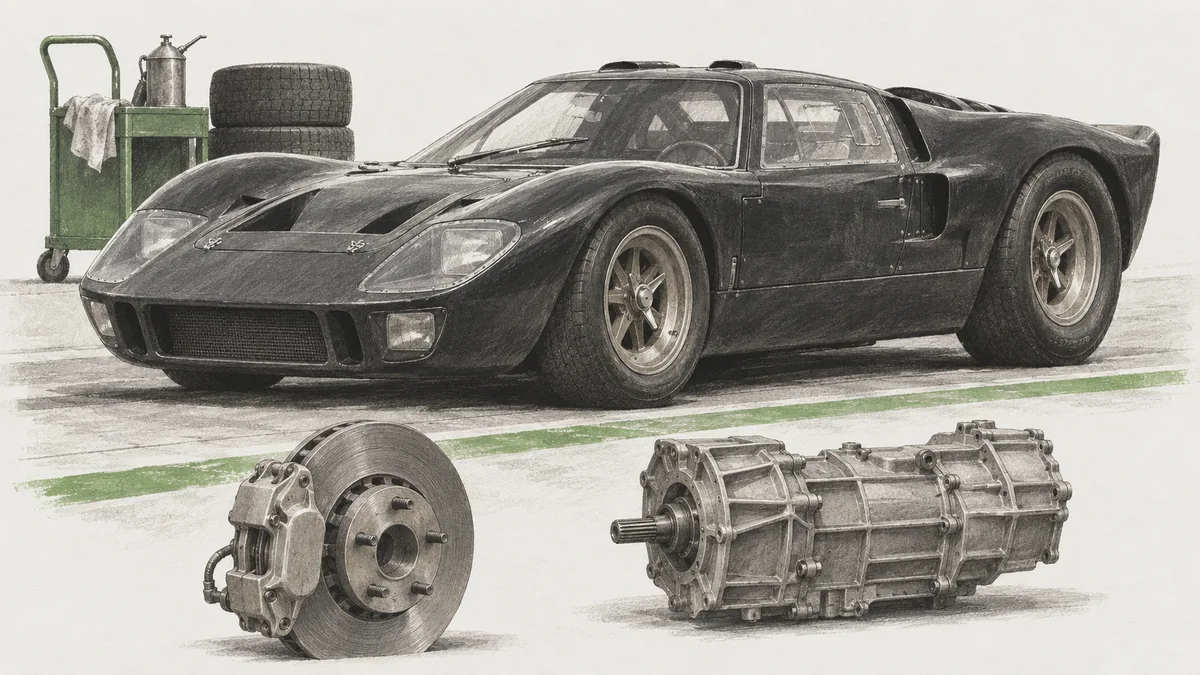
The Ford GT40's 1966 Le Mans victory was about more than a powerful engine. The project required changes to how work was organised, extensive testing and solutions to braking and transmission problems.
Behind the rivalry was an engineering programme
The GT40 story is often told as a personal conflict between Ford and Ferrari. That makes a useful film plot, but leaves out the most instructive part: how an ambitious car becomes capable of finishing a 24-hour race.
Ford's historical archive describes an important organisational step before the 1966 season: establishing the Le Mans Committee. It brought company divisions together and simplified decision-making. Holman & Moody joined the programme alongside Shelby American. This was the work of several teams, not a story of one person fixing the entire project alone.
Why a big engine did not solve every problem
The Mark II used a large engine from the 427 family and a four-speed gearbox. Ford's archive identifies brakes and transmission among the main engineering concerns. Development work covered the body, suspension, fuel system and aerodynamics.
Preparation included a bench-testing programme that reproduced Le Mans loads. The aim was to keep the engine running considerably longer than the race itself. This illustrates the difference between peak power and suitability for prolonged load: the first number looks good in advertising, while the second determines whether the car can finish.
What happened in 1966
Ford took all three podium places at Le Mans. Bruce McLaren and Chris Amon were the winners. The history from race organiser ACO places the result within the wider GT40 programme rather than merging different versions into an imaginary “car from the film”.
Historical writing needs to retain the designations. The GT40 Mark I, Mark II and later racing Fords should not be assigned identical engines and engineering simply because they look similar.
Why the story matters today
The editorial lesson is simple: a car is a system. More power is not enough if cooling, brakes and transmission durability remain unchanged. Discussion of a prepared car should therefore begin with its task, operating conditions and testing, not the largest number in its specifications.
The GT40 also illustrates complex-project management. Extra budget helps only when responsibility is clear, data are accessible and problems can be corrected quickly once found.
How to look at a museum GT40
Start with the individual car's label: year, version, team and verified racing history. A replica can be an excellent car in its own right, but cannot be described as an original Le Mans entrant. Provenance matters more than paint and stickers here.
Questions and answers
Did Ford win Le Mans in 1966 through power alone?
No. The company archive describes extensive work on reliability, brakes, transmission, testing and programme organisation.
Are all GT40s technically identical?
No. Versions differed, so specifications must be linked to the particular version and year.