KULT Drive · Updated
Ford Model T: the revolution happened beyond the bonnet
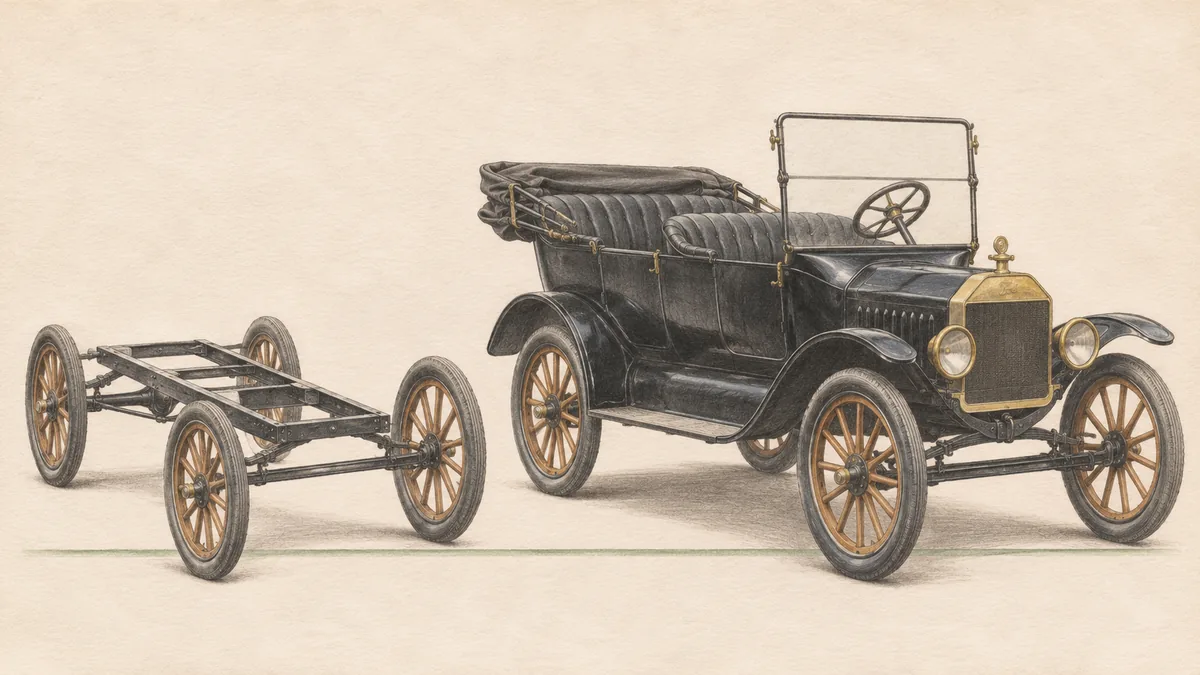
The Ford Model T matters as more than an early twentieth-century mass-market car. Its history shows how organising production can transform affordability more than a single technical innovation.
A car for a much wider audience
The Model T appeared in 1908. It holds a special place in Ford’s history as the car that helped turn an expensive purchase for a small group into more accessible transport. Model T history.
To understand the model, it helps to move beyond familiar horsepower comparisons. Its significance lies in repeatable production, the ability to build many identical cars and gradually falling costs. A technical product became part of an industrial system.
The assembly line changed the question of price
In 1913, Ford introduced a moving assembly line at Highland Park. The company’s official history links production changes to the Model T’s falling price: from $825 in 1908 to $260 in 1925. These are historical prices for those years, not amounts adjusted to today’s money. Ford on the assembly line.
It would be wrong to claim that nobody before Ford divided work into operations or used flow production. The Model T story’s strength is the scale and consistent application of the approach to the car.
Why the black-paint myth is incomplete
The Model T came in different colours during different production periods. Ford states that black-only paint applied to a specific interval, 1914–1925, rather than the model’s entire history. Model archive.
This small fact makes the story more accurate. A convenient legend often displaces chronology, even though changes over the years explain actual production decisions. With a historical car, it always helps to ask which period is being discussed.
What the Model T says about today’s market
A low price does not necessarily come from abandoning every useful feature. It can result from standardisation, scale, supply organisation and assembly. But standardisation also limits choice, so manufacturers continually balance affordability and variety.
This is an editorial conclusion drawn from industrial history, not a promise that every modern mass-market car will be cheap to repair. Purchase price and ownership cost remain separate questions.
The Model T deserves to be remembered as a car that changed the factory as well as the road. Its central technical context is not confined to what lies under the bonnet: it extends into workshops, logistics and the organisation of repeatable work.
Questions and answers
Was the Model T always available only in black?
No. The black-only period was limited; other choices existed before and afterwards.
Did Ford invent all assembly-line production?
That generalisation is inaccurate. Ford’s importance lies in developing and widely implementing the moving assembly line in car production.