KULT Drive · Updated
Jaguar E-type: beauty with racing logic behind it
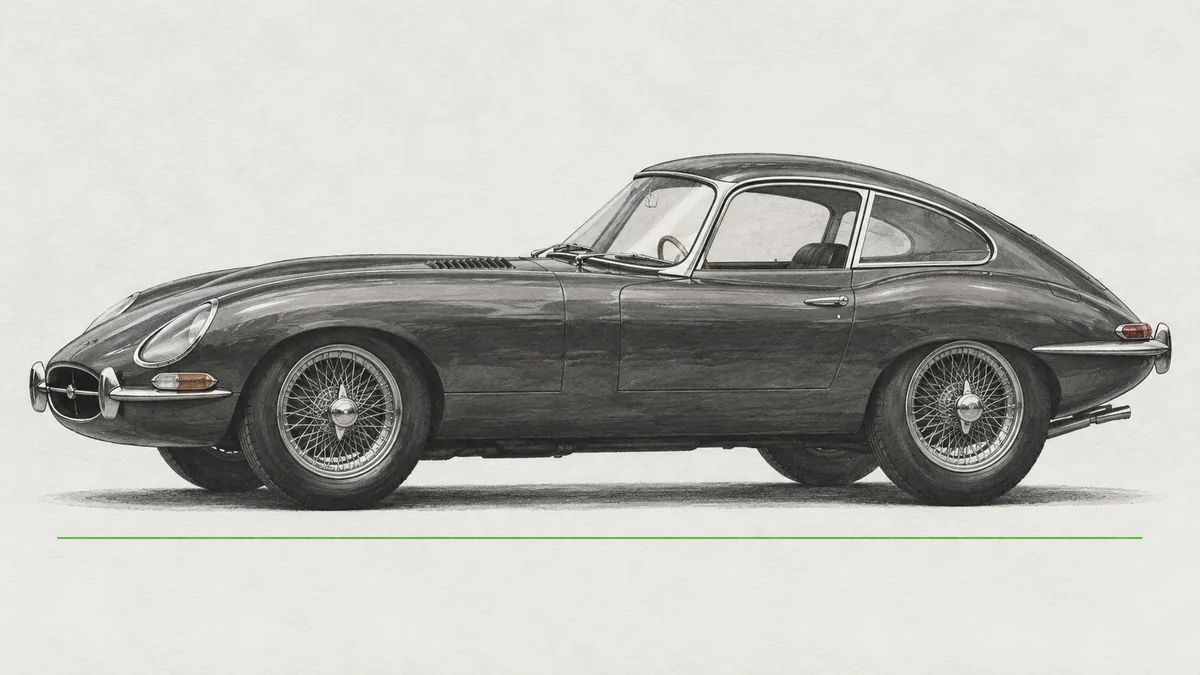
The Jaguar E-type is more than a famous 1960s silhouette. Its shape and engineering are linked to the marque's racing experience, while its debut shows how a road demonstration can amplify a show car's impact.
The Geneva debut and the car that had to hurry
The E-type appeared before the public in Geneva in March 1961. One demonstration car was the open-top 77 RW, which test engineer Norman Dewis drove overnight from Britain in approximately 17 hours. The Jaguar Daimler Heritage Trust preserves the history of this individual car. 77 RW archive.
It is easy to turn this episode into a romantic legend, but its meaning is practical: visitors wanted not only to see the new car, but also to experience it in motion.
Form did not exist separately from engineering
The E-type drew on experience with the racing D-type, and its appearance was linked to aerodynamicist Malcolm Sayer's work. Early cars had a 3.8-litre inline-six. Jaguar's historical material highlights the combination of high speed for its era and a relatively accessible sports-car price. Jaguar on the E-type's fiftieth anniversary.
That does not make it inexpensive by today's collector-market standards. The historic price of a new car and the current value of a rare example are different figures and should not be confused.
Why the long bonnet is so memorable
The E-type's silhouette relies on strong contrasts: an extended front, compact cabin and smoothly finished rear. It makes a clear visual statement even to someone unfamiliar with the engine and suspension.
But beauty remains subjective. The story does not need a questionably sourced quotation from a famous designer to explain the car's appeal. Showing the shape and its connection with the layout is much more useful.
One name, several different cars
The family changed: engine capacity, body styles and other features evolved during production. An early roadster's specifications cannot automatically be applied to a later version. When discussing speed, it is especially important to distinguish a claimed figure, a particular test and an actual surviving car.
A classic-car owner also buys condition and restoration history, not just a name. Documents, correct parts and workmanship determine how clearly future ownership can be understood.
What remains beyond the numbers
The E-type shows that recognition comes when proportions, purpose and technical history support one another. It is worth studying as a strong response to the challenges of its time, rather than a museum ideal that every new car must match.
A good story begins with its silhouette, explores its racing roots and ends with the real car 77 RW. A beautiful object then becomes a verifiable history.
Questions and answers
Was the E-type initially produced only as a roadster?
No. The early family included an open two-seater and a coupé; other versions came later.
Can the same top speed be attributed to every E-type?
No. It depends on the version, test conditions and condition of the car. A historical claimed figure must be identified as such.