KULT Drive · Updated
Lamborghini Miura: how the engine changed the shape of the supercar
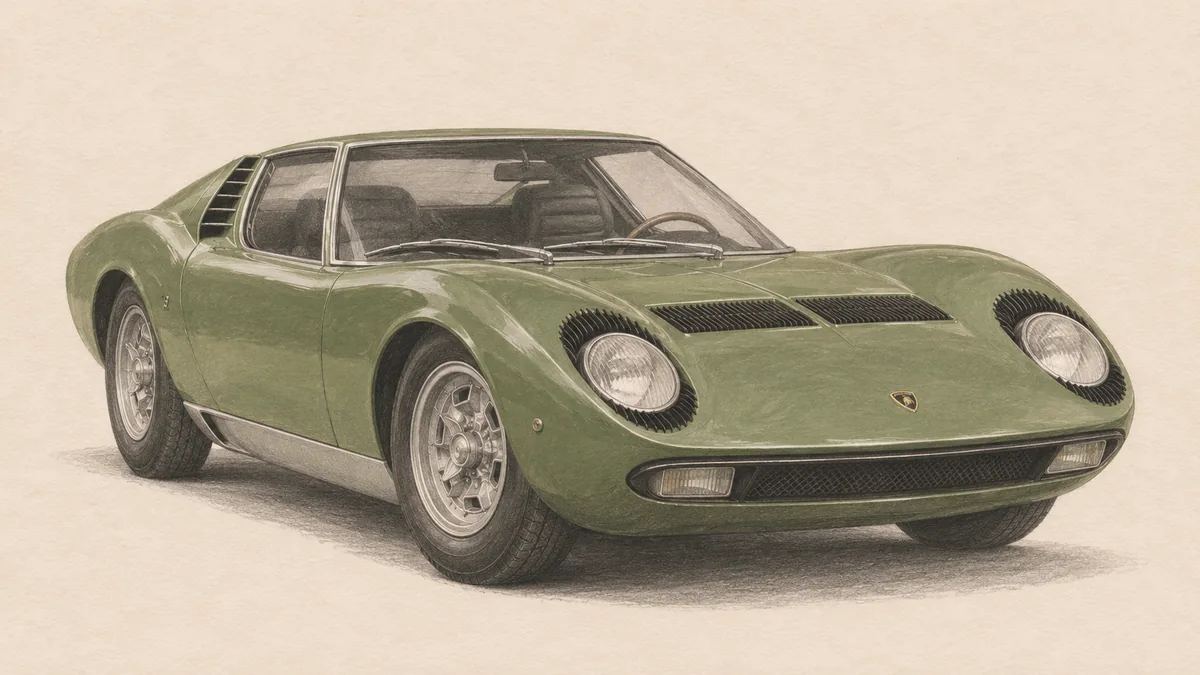
The Miura became Lamborghini's first mid-engined car. Its transverse V12 enabled a compact, low design, while posing difficult challenges in packaging the engine and gearbox.
A car that is hard to mistake
The Miura was shown at the Geneva Motor Show in March 1966. Today it is easy to see it simply as a beautiful classic Lamborghini. Behind the silhouette, however, lay a major architectural change: the engine sat behind the cabin and ahead of the rear axle, rather than beneath a long front bonnet.
Lamborghini's archive highlights the transverse V12. This layout helped shorten the wheelbase but complicated the relationship between engine and transmission. Appearance and engineering cannot be considered separately here: component placement determined the proportions.
Why the Miura looks the way it does
Bertone created the body. A low nose, long flowing surfaces and distinctive headlight treatment made the car recognisable. The rear louvres were not merely decoration: they helped remove heat from the engine compartment.
This is a good example of a technical necessity becoming a visual signature. A design story is more interesting when it explains a detail's function rather than simply calling the car “one of the most beautiful”.
P400, S and SV are not the same
According to the manufacturer, the early P400 produced 350 CV, the S 370 CV and the SV 385 CV. Introduced in 1971, the SV brought chassis and suspension changes, a wider rear and different exterior details. These specifications belong to historical versions, not to every car carrying a Miura badge.
Lamborghini's V12 history traces the idea's development. When assessing an individual car, factory configuration and modification history matter: a restored car can resemble a later version without sharing its origins.
What the Miura explains about supercars
Our editorial conclusion: architecture can shape an entire category of desire. A buyer notices the silhouette before understanding the layout, but the impression is created by the relative positions of the wheels, cabin and engine.
The story should not become an argument over which car alone deserves to be called the “first supercar”. The term has no single universal technical boundary. It is more precise to say that the Miura became one of the defining images of the mid-engined sports car.
What to show in a video
Compare a diagram of a front-engined coupé with the Miura, then explain the transverse V12. Finish by comparing the P400 and SV in archive photographs. This reveals the engineering without inventing driving impressions of a car the author has never driven.
Questions and answers
Where is the Lamborghini Miura's engine?
Mounted transversely behind the cabin and ahead of the rear axle.
Why can SV specifications not be used for every Miura?
The P400, S and SV differ in power and several engineering details; the exact version must be identified.