KULT Drive · Updated
Lancia Stratos: a car with rallying as its central purpose
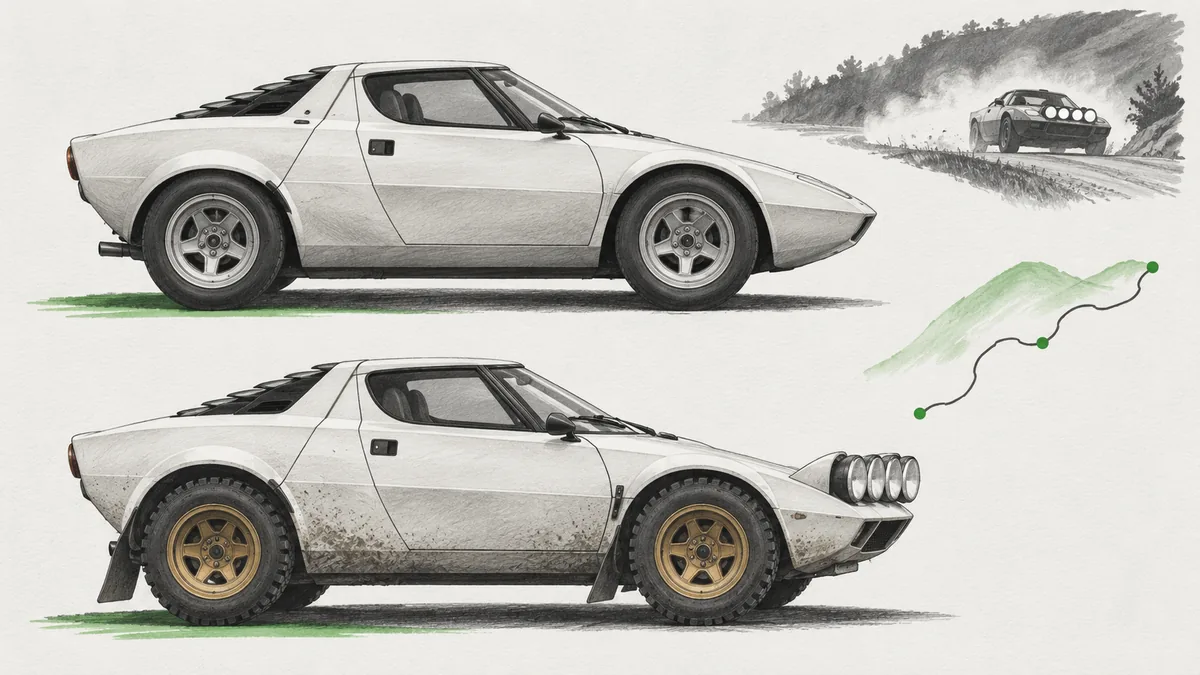
The Lancia Stratos became one of the clearest examples of a car developed around rallying. Its historic achievements include three consecutive World Rally Championship manufacturers’ titles, from 1974 to 1976.
Not an ordinary car subsequently made sporting
Many racing cars develop from a mass-produced road-car base. The Stratos is interesting for the opposite direction of thinking: first the sporting task, then a shape and structure serving it.
Lancia’s historical account identifies it as one of the key purpose-built rally cars. That is a useful starting point, although absolute “world’s first” claims require the class and period to be defined. Understanding the Stratos’s significance does not require that debate.
Which results are confirmed?
Stellantis Heritage and Lancia record three world manufacturers’ titles in 1974–1976. The model’s history also highlights Monte Carlo victories and Sandro Munari’s performances.
A manufacturers’ title should not be confused with an individual drivers’ championship: the structure of rally competition has changed. Describing the achievement precisely makes the story stronger, not less impressive.
Why the shape is so memorable
The short, expressive body and prominent cabin made the Stratos the visual opposite of an ordinary saloon. Racing livery makes the architecture especially clear: the car looks like a tool created for a specific environment.
Our editorial assessment: strong design does not necessarily begin with a desire to surprise. Sometimes an unusual shape emerges because its creators consistently solve an unusual task. That is a good reason to discuss proportions and visibility, not just the colours of sponsors’ stripes.
Road version and rally preparation
Cars built to homologate a sporting programme and the vehicles of a particular team cannot be described by one universal specification. Preparation, regulations, season and later modifications can substantially alter their characteristics.
The same caution applies when considering a replica. Recreating the shape can be an interesting project in its own right, but it does not automatically acquire a factory racing car’s history. Its origin should be disclosed plainly.
What the Stratos explains about engineering
Its story shows the power of specialisation. A car optimised for a particular task does not have to be the best choice for everyday city driving. Sporting success and day-to-day convenience are different criteria.
For video, use a map of the rallying era, archive footage with appropriate rights and a simple comparison with a contemporary road car. The main question is not “how much does it cost?” but “why did the engineers choose this particular car for this job?”
Questions and answers
Which world titles are associated with the Stratos?
Lancia won the manufacturers’ championship with it in three consecutive years: 1974, 1975 and 1976.
Does a Stratos replica have the same collector history?
No. A replica is a separate vehicle; the original’s history and provenance do not transfer to it.