KULT Drive · Updated
Mazda Cosmo Sport: why Mazda kept believing in the rotary engine
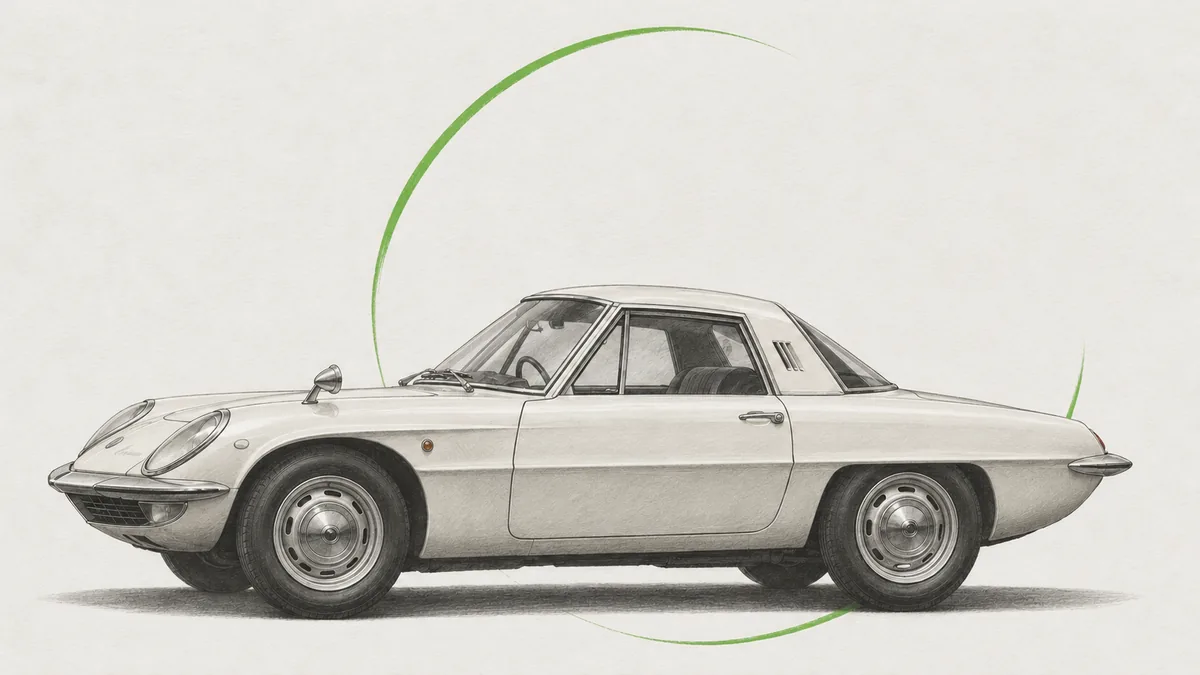
Mazda Cosmo Sport was a major step in developing the production twin-rotor engine. Its story is not a promise of perfect technology, but years of work on seals, durability and refining an unusual design.
Why this car came about
In the early 1960s, Mazda was seeking its own technical direction. The rotary engine offered the chance to create a car distinguished by more than its badge or body styling.
According to Mazda’s historical archive, development began in 1961. Damage to the rotary engine housing’s internal working surface was one of the toughest problems. Work on seal materials became an important part of development. This is a story of engineering effort, not the sudden arrival of a fully finished invention.
From motor show to sale
The prototype was shown in Tokyo in 1963, while the production car reached the market on 30 May 1967. The archive lists the early Cosmo Sport’s specifications: two rotor units of 491 cc each and an output of 110 PS. Its stated top speed was 185 km/h.
Mazda’s anniversary publication helps distinguish the dates of display, announcement and sales launch. For a historical account, that matters more than the appealing but inaccurate idea that “the car appeared in a single day”.
What makes the rotary layout unusual
In a conventional piston engine, piston movement is converted into crankshaft rotation. In a rotary engine, the working process centres on a rotating rotor. This is a different engineering approach, not simply an oddly shaped conventional cylinder.
Comparing these engines only by their stated displacement is misleading: their design and working-cycle arrangements differ. Two figures on a boot lid therefore do not fully explain power, consumption or loads.
What not to promise the reader
The Cosmo cannot prove that every rotary car is reliable or unreliable. An individual car’s condition, operating requirements and servicing quality need separate study. Historical success in development does not remove technical compromises.
The editorial value of the story is persistence. Mazda did not stop at an impressive prototype, but developed an unusual idea into a product. The journey, however, was longer and harder than the motor-show impression might suggest.
Why show the Cosmo today?
The story explains the difference between a promising concept and technology ready for use. Automotive news often mixes those stages. The Cosmo makes it possible to discuss testing and service life without advertising the next “revolutionary” engine.
For a video, an archive image of the car, a simple animation of the two engine layouts and a timeline from development to sales are enough. The key is not to depict later rotary Mazdas as technically exact copies of the Cosmo Sport.
Questions and answers
When did the Mazda Cosmo Sport go on sale?
On 30 May 1967, after several years of development and testing.
Can rotary and piston engine displacement be compared directly?
One figure is not enough: their design and the way their working processes operate differ.