KULT Drive · Updated
Mazda MX-5: why driving enjoyment is not measured in power alone
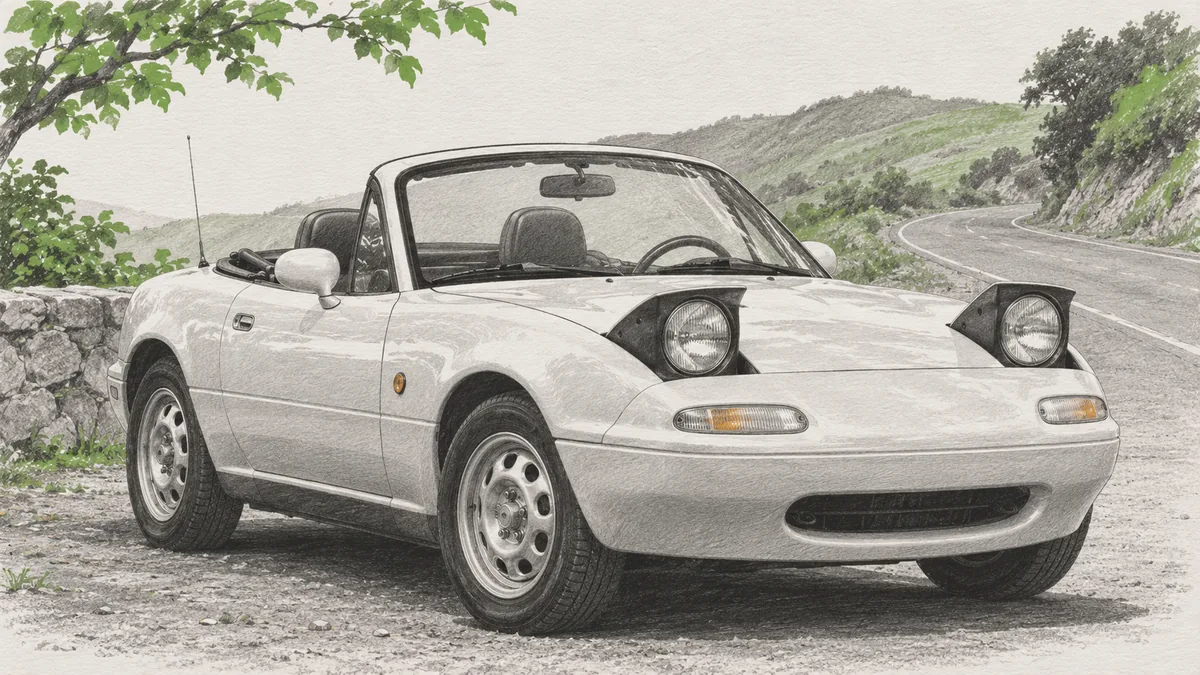
The Mazda MX-5 was developed around lightness and the connection between driver and car, not maximum power. The first car was shown in Chicago in February 1989. Mazda describes its concept as Jinba Ittai: horse and rider as one.
Not an attempt to win every numbers race
When sports cars are compared on power alone, a small roadster looks modest. But the MX-5 answers a different question: how much car is needed for the driver to feel its responses and enjoy an ordinary journey?
Mazda’s development history explicitly discusses restraining increases in power and features to control weight. This does not mean an absence of engineering. On the contrary, limiting weight requires careful selection of the solutions that are genuinely useful.
Why Jinba Ittai is more than a slogan
Mazda uses the image of horse and rider as one to describe harmony between car and person. In this approach, size, control placement and the nature of the response matter as much as the engine.
In editorial terms, this can be explained as an effort to reduce the distance between the driver’s intention and the car’s reaction. But the experience is always personal; a historical account should not present an advertising promise as its own driving experience.
How the first MX-5 appeared
An official anniversary release confirms that the first MX-5 premiered at the Chicago Auto Show in February 1989. In different countries, the model is also known as Miata and Roadster.
When discussing specifications, identify the generation and market. The original car and later versions develop the same idea, but differ in bodywork, engines, equipment and safety requirements.
Why simplicity is not primitiveness
A good simple product is not one that happens to lack something. It is the result of selection. Removing equipment without understanding the overall task can create an inconvenient car. If weight, driving position and response are coordinated from the outset, minimalism becomes an advantage.
This idea makes an interesting contrast with the familiar equipment list. Sometimes it is more useful for buyers to define how they want to use the car than to select the maximum number of items in the catalogue.
What to consider when buying a classic roadster
Historical reputation does not replace inspection of the body, roof, suspension and evidence of modifications. Added tuning parts should be assessed for installation quality and suitability for the task, not automatically treated as improvements.
For KULT Stories, the MX-5 is a story about having just enough. It should be told without claiming that a small car suits everyone. The point is different: a good car starts with a clear idea, not a maximum in every specification column.
Questions and answers
When was the first Mazda MX-5 shown?
At the Chicago Auto Show in February 1989.
Are MX-5, Miata and Roadster always different models?
These names are used for the family in different markets; specific characteristics still require checking the generation and specification.
Sources
- Mazda — MX-5 development concept.
- Mazda — Mazda MX-5 celebrates 20th birthday. Published: 2009-02-12.