KULT Drive · Updated
McLaren F1: why the driver sat in the middle
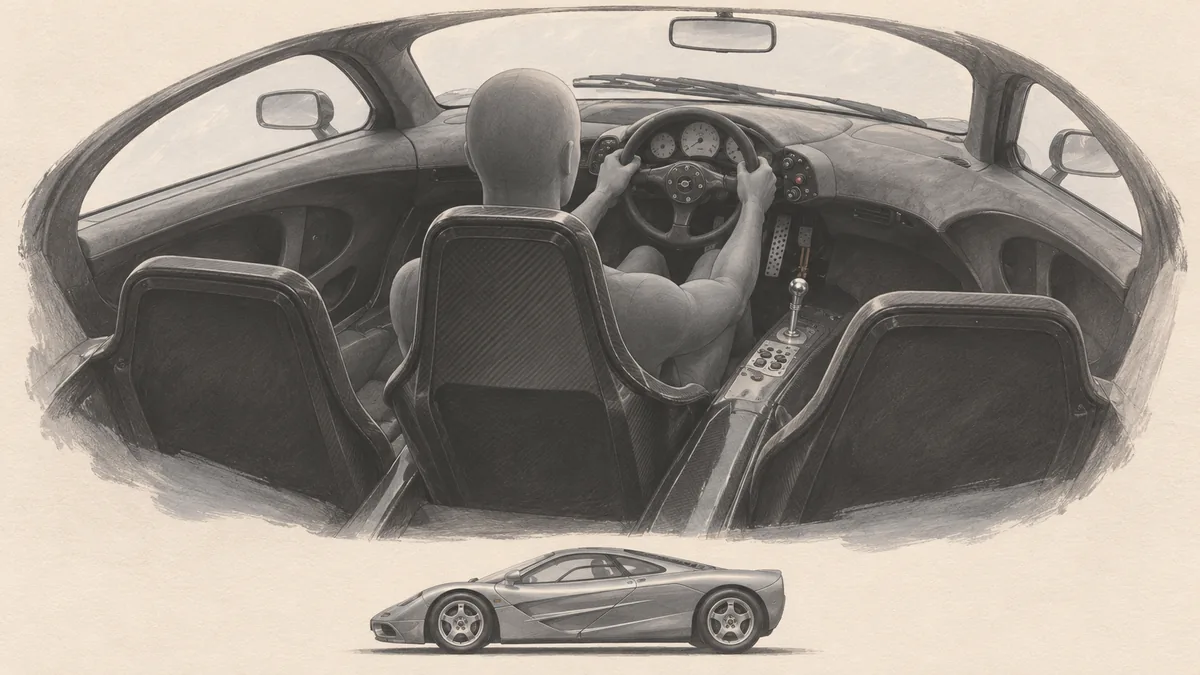
The McLaren F1 is known not only for speed but for its unusual layout: the driver sits centrally, with two passengers to either side and slightly behind. The road-car concept led to a racing version that won Le Mans in 1995.
A car built around the driver
When a cabin starts with a central driving position, the usual questions of left- or right-hand drive recede into the background. In the McLaren F1, the unusual seating position was part of the overall architecture, not a show trick.
The Canadian International AutoShow’s official McLaren F1 account dates the car’s introduction to 1992 and describes its three-seat layout with a central driver, carbon-fibre structure and 6.1-litre BMW V12. BMW M separately confirms the S70/2 engine’s origin and displacement. This is a description based on sources, not our own road test.
Why change the familiar seating position?
In editorial terms, the central position is readily explained through symmetry. The driver sits in the same position relative to the car when turning either way. But an unusual layout also creates its own requirements for cabin access, passenger accommodation and use of space.
There are no free advantages in engineering. The F1 is interesting because its developers chose a particular objective and coordinated the other decisions around it.
The road car goes racing
McLaren Racing confirms the F1’s Le Mans victory at its first attempt in 1995. The cars took four of the top five places. That is an impressive result, but it applies to prepared racing cars, not a road example randomly taken from a garage.
The distinction matters. Saying “a road car won Le Mans” conveys the project’s origins, but does not describe all the preparation, tuning and team effort.
Why the speed record is not the only topic
The F1 is often discussed in terms of top speed and market price. Yet questions about why it needed three seats, how luggage was accommodated and why a particular powertrain was chosen are much more substantial.
These details make the car an engineering statement in its own right. It is interesting even to a reader who never intends to buy a rare supercar.
What not to promise a collector
A model’s prestige does not make every example a risk-free investment. Ownership history, structural changes, maintenance and provenance affect its assessment. A road F1, LM and racing GTR cannot be treated as interchangeable just because they share a name.
A strong account of the McLaren F1 rests not on exaggeration but on a clear idea: cars can be designed differently if the task is defined first. The central seat is the most visible consequence of that approach, but far from the only one.
Questions and answers
How many seats does the road-going McLaren F1 have?
Three: a central driver’s seat and two passenger seats to either side, set slightly behind.
Did an ordinary, unprepared road F1 win Le Mans?
No. A racing version won in 1995; road-car origins do not remove the need for special preparation.