KULT Drive · Updated
Mercedes-Benz 500 E: why Mercedes needed Porsche’s help
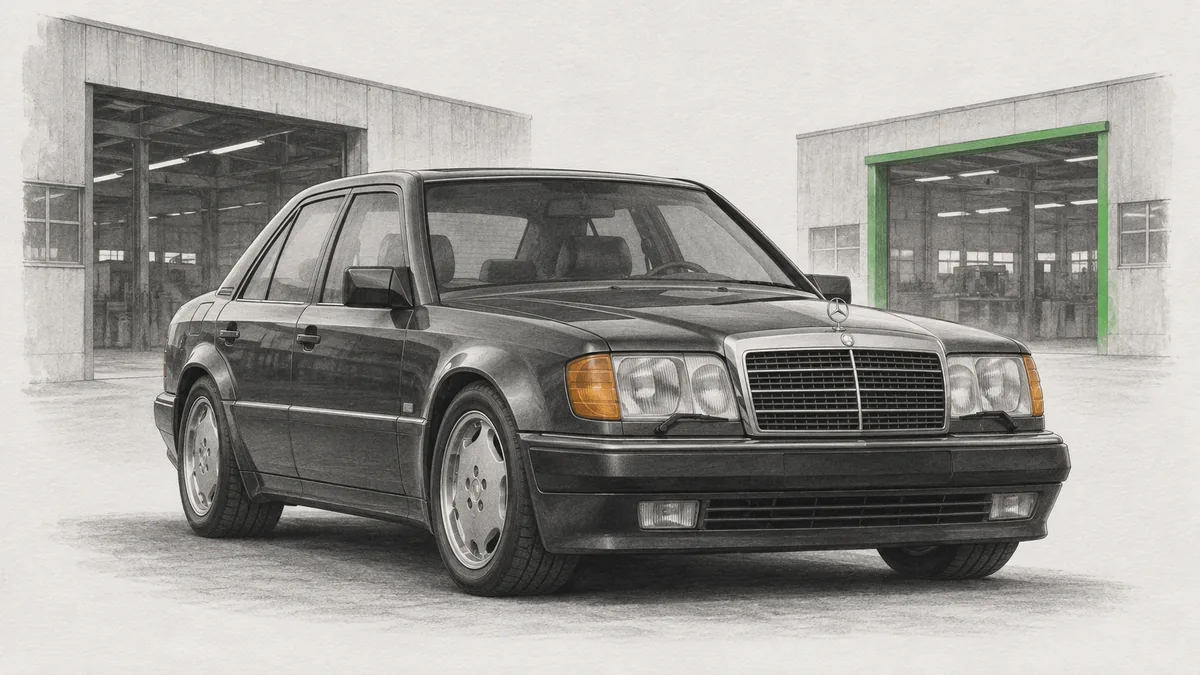
The Mercedes-Benz 500 E was developed with Porsche’s involvement under a Daimler-Benz commission. Combining the W124 body with a five-litre V8 required comprehensive engineering and a special production process, not just fitting an engine.
Why it is not simply a W124 with another engine
The Porsche archive states that the development commission arrived in 1988. The car was shown in Paris in 1990, and sales began in spring 1991. In 1993, it was renamed E 500 as part of the range update.
The project used the 500 SL’s five-litre V8. But the collaboration was not about mechanically swapping an engine: the body, chassis, brakes and packaging all had to be coordinated.
How the car travelled between factories
Porsche describes an unusual production sequence. Body parts arrived from Sindelfingen in Zuffenhausen, where the body was assembled. It then went back for painting, before final assembly and engine installation took place at Porsche.
The process shows that an automotive project can be shared at more than the logo level. Real cooperation involves equipment, people, logistics and quality control.
Understated looks did not mean ordinary engineering
Widened wings helped distinguish the 500 E from a basic W124. It remained a four-door saloon but had its own technical features. The archive also emphasises the four-seat interior.
Our editorial conclusion: this is an example of a sporting car without obligatory showiness. But that image does not mean its characteristics can be obtained simply by fitting similar wings and a badge.
An original and a conversion are different purchases
Factory origin and documents matter to collectors. An ordinary W124 altered to resemble a 500 E can be an interesting project, but it should be sold as a conversion. A full assessment concerns not just the engine but every related system.
Nor should every old Mercedes automatically be treated as a Porsche product. The collaboration concerns a specific programme, not the whole W124 family.
Why this story is worth remembering
It challenges the simple notion that competing brands always work in isolation. Sometimes one company’s engineering expertise and available production capacity help another realise an unusual product.
A map of the route between factories, a component diagram and a body comparison with the basic W124 are enough to tell the story. The 500 E then emerges not as a collection of rumours about “the definitive Mercedes”, but as a well-documented example of automotive cooperation.
Its appeal lies in the project’s coherence. That is what distinguishes the factory result from the idea that a sporting saloon can be created through a single engine swap.
Questions and answers
Was Porsche involved in creating the Mercedes-Benz 500 E?
Yes. Porsche received the development commission and participated in this model’s production process.
Does every W124 with a V8 become an original 500 E?
No. Originality is established by factory documents and provenance; a conversion must be identified separately.