KULT Drive · Updated
Mercedes-Benz G: how a working off-roader became a status symbol
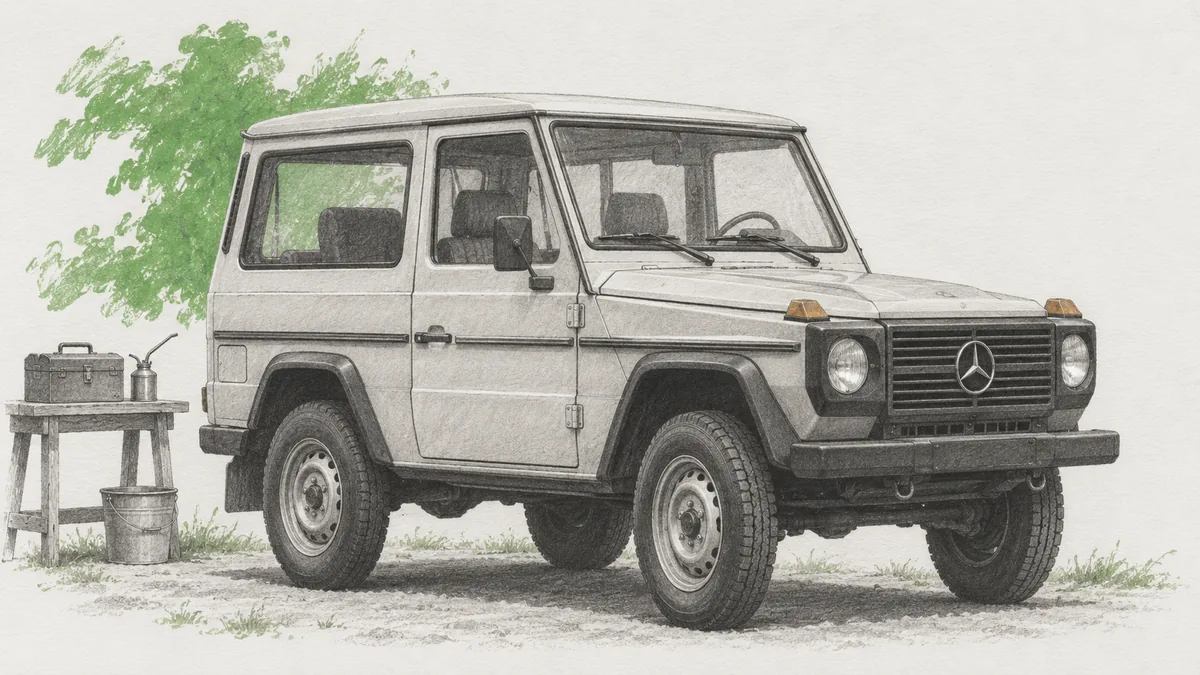
The Mercedes-Benz G arrived in 1979 as a versatile off-roader with extensive working capabilities. Its modern status developed over a long period; it was not the project’s sole original objective.
It did not begin with luxury alone
Today, it is easy to picture a G-Class outside an expensive hotel. But the Mercedes-Benz archive describes the 460 series’ February 1979 premiere through different priorities: capability both off-road and on-road, and a wide range of uses.
The first vehicles were shown in Toulon. The production story is linked to Graz, Austria. Understanding this matters more than a modern list of decorative options: the G was conceived as an engineering project in its own right, not a tall body on an ordinary passenger car.
Why its recognisable shape survived for decades
Straight lines and almost vertical surfaces made the silhouette a lasting visual signature. But a similar appearance does not mean an absence of development. The manufacturer emphasises the model’s continual refinement throughout its history.
This brings out a useful distinction between identity and remaining unchanged. A vehicle can keep its character while substantially changing its engineering, comfort and safety. Judging a generation only by how familiar the body looks is not enough.
The scale of the story
In its announcement of the 500,000th vehicle, dated 20 April 2023, Mercedes-Benz marked a production milestone. That figure covers the entire programme, not one AMG version or a single year.
Buyers of a classic G should be particularly careful not to confuse early utilitarian versions with later expensive models. A shared name and similar doors do not give them identical operating characteristics or maintenance costs.
Where collector appeal comes from
Our editorial assessment: the G is interesting for its combination of a long history, recognisability and varied roles. But neither age nor the model’s popularity guarantees that a particular example will increase in value.
When assessing a vehicle, distinguish its factory configuration from later modifications. A body kit, interior and wheels may change its appearance without changing the chassis’ year or origin. An honest description should make this clear immediately, not leave it to be discovered after a deposit is paid.
What to tell in KULT Stories
A strong narrative compares the original working brief with the vehicle’s modern role. There is no need to set them against each other: a long-lived model can serve different owner expectations.
The G’s history also reminds us why context matters when buying. One person wants a documented, original classic; another wants a comfortable modern SUV; a third wants a personalised vehicle. These are different tasks with different criteria for a good example.
Questions and answers
When did the Mercedes-Benz G appear?
The first 460 series was introduced in February 1979.
Does a newer-generation body kit change the vehicle’s year and model?
No. Its identity is established by documents and factory configuration; exterior alterations must be disclosed to the buyer.
Sources
- Mercedes-Benz Classic — 40 Jahre Mercedes-Benz G-Klasse. Published: 2019-02-06.
- Mercedes-Benz — 500,000th G-Class.