KULT Drive · Updated
Porsche 911: how changing one digit became part of a larger story
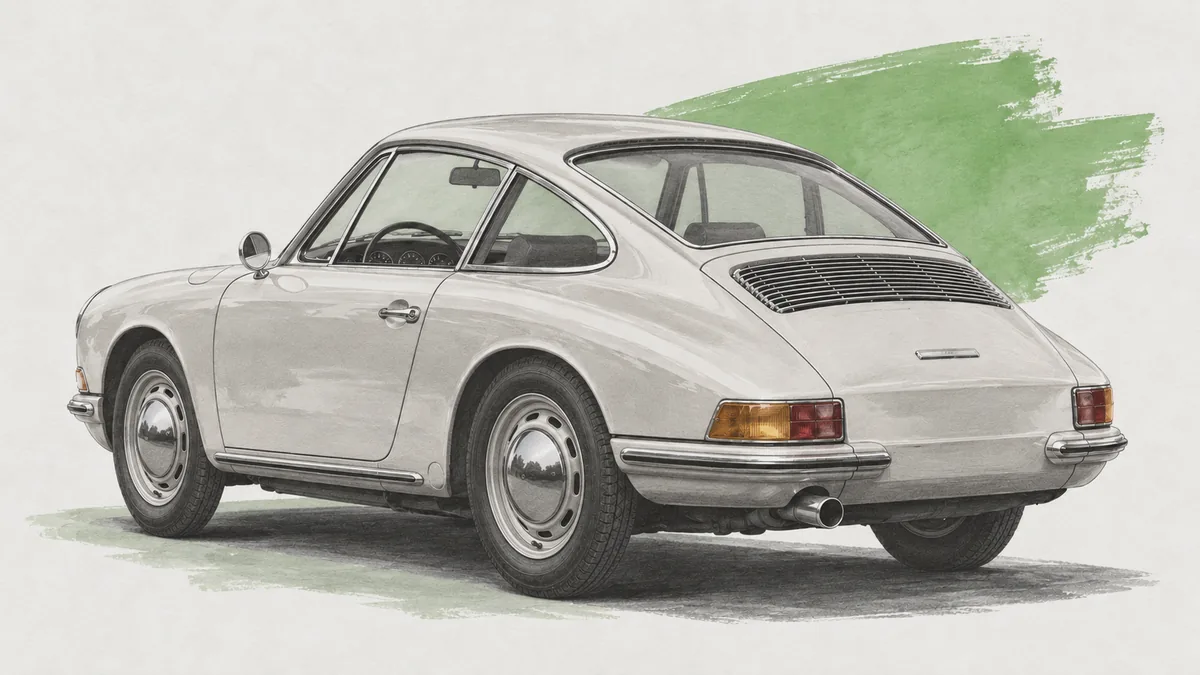
The Porsche 911 debuted as the 901 in 1963 and gained its familiar name as production began in 1964. Its story goes beyond renaming: it is an example of the long development of one recognisable concept.
A successor that needed to do more than repeat the 356
At the 1963 Frankfurt Motor Show, Porsche presented the 901 as the successor to the 356. The new car retained the broad idea of a compact sports car but had its own design and a rear-mounted six-cylinder engine. The first-generation 911.
Moving to a new model always carries risk: too much change can alienate the existing audience, while too little may fail to meet new needs. The early 911 is interesting precisely for this balance between continuity and renewal.
Why the 901 became the 911
After Peugeot objected to the designation with a zero in the middle, Porsche changed the model number. Production of the 901 began on 14 September 1964, and the car soon became the 911. The renaming story.
Today, this detail seems an almost inevitable part of the legend. It is more useful, however, to see the everyday reality of the automotive business: even a well-developed technical product exists in a world of names, rights and markets.
Engineering became recognisable character
The early 911 had an air-cooled flat engine at the rear. According to Porsche, the initial six-cylinder version produced 130 PS. Different power outputs and versions followed, including the Targa. First-generation archive.
This should not become a claim that all 911s are always the same. Keeping a recognisable idea does not rule out major changes to suspension, safety, cooling and controls.
Why evolution is harder than it looks
When the visual identity must remain familiar, engineers and designers have to meet new requirements within certain boundaries. In this sense, developing the model is a particular kind of challenge, not an absence of creativity.
This is an editorial assessment, not proof that the 911 is superior to every other layout. Mid-engined, front-engined and rear-engined designs involve different compromises. Porsche's story is interesting for how consistently the chosen approach developed.
How to discuss the 911 without mixing generations
Specify the year and series. Do not transfer a modern car's electronic systems to an early car or promise that every version behaves identically. Even within one generation, an individual car's condition and modifications matter.
The 911 deserves attention as a long engineering conversation, not a formula discovered once and for all. Its recognisability shows that technical progress and identity can coexist, provided real work continues behind the familiar silhouette.
Questions and answers
Why did Porsche change the 901 name?
The marque's history links it to Peugeot's objection to a designation with a zero in the middle.
Are all Porsche 911s air-cooled?
No. Air cooling belongs to the early generations; specifications must be checked for the particular series.