KULT Drive · Updated
Range Rover 1970: how a utility off-roader became an everyday car
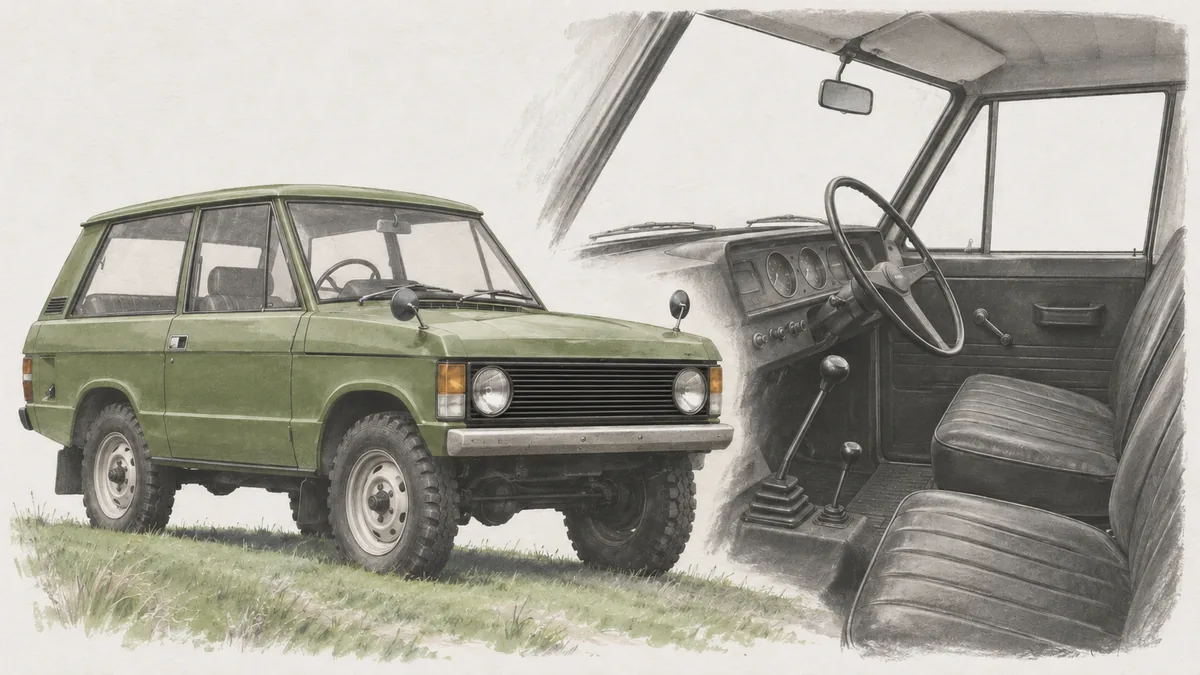
The first Range Rover combined off-road ability with comfort on road journeys. Launched in 1970 with two doors, it evolved gradually, so the image of the later luxury SUV cannot be applied fully to the early car.
More than another working off-roader
The Range Rover idea expanded a vehicle’s role: it should cope not only with poor roads, but also with normal long-distance journeys. JLR’s historical overview connects the project with work on the 100-inch station wagon prototype in 1966 and the first Range Rover’s launch in 1970.
This clarifies its significance. It was not the sudden invention of four-wheel drive, but a search for a new combination of familiar qualities. The combination could matter more than any individual detail.
Why the early car differs from familiar luxury
The first Range Rover had a two-door body. The factory four-door version came later, in 1981, and an automatic gearbox was added in 1982. An early Classic photograph should therefore not be accompanied by a later version’s equipment list.
The model evolved for more than a quarter of a century. Over such a long history, not only the engine and trim change, but the car’s role for its buyer. The shared Classic name covers a whole sequence of versions.
From utility shape to design object
Range Rover’s article on art and design describes a 1971 exhibition at the Musée des Arts Décoratifs in Paris, where a detailed 1:4-scale Range Rover model was displayed. It is an interesting episode, but should not become the inaccurate legend of “the only car permanently displayed in the Louvre”.
The exhibition recognition has a simpler significance: a car can be considered as industrial design. Proportions, visibility and body layout can attract interest independently of the amount of leather or decorative detail.
What Range Rover tells us about SUV development
Our editorial conclusion: one strong automotive idea is reducing the number of compromises people have to make every day. Buyers may want off-road ability, while still making most journeys on ordinary roads.
Versatility, however, does not mean an absence of limitations. For an individual classic car, consider age, condition, modifications and access to qualified servicing. Model history does not replace checking the particular example.
A story worth filming
Compare an early two-door Classic with a later four-door car, without trying to declare one “real” and the other wrong. Showing how the original idea adapted to changing owner expectations is more interesting.
That is why the Range Rover remains a useful historical example: its evolution explains changes in everyday comfort as well as automotive technology.
Questions and answers
Was the first Range Rover a five-door?
No. It entered the market as a two-door in 1970; the factory four-door version arrived in 1981.
Can all Range Rover Classics be treated as identical?
No. The long production run brought many changes, so year and specification matter.