KULT Drive · Updated
Toyota Land Cruiser 40: how a working vehicle became an automotive icon
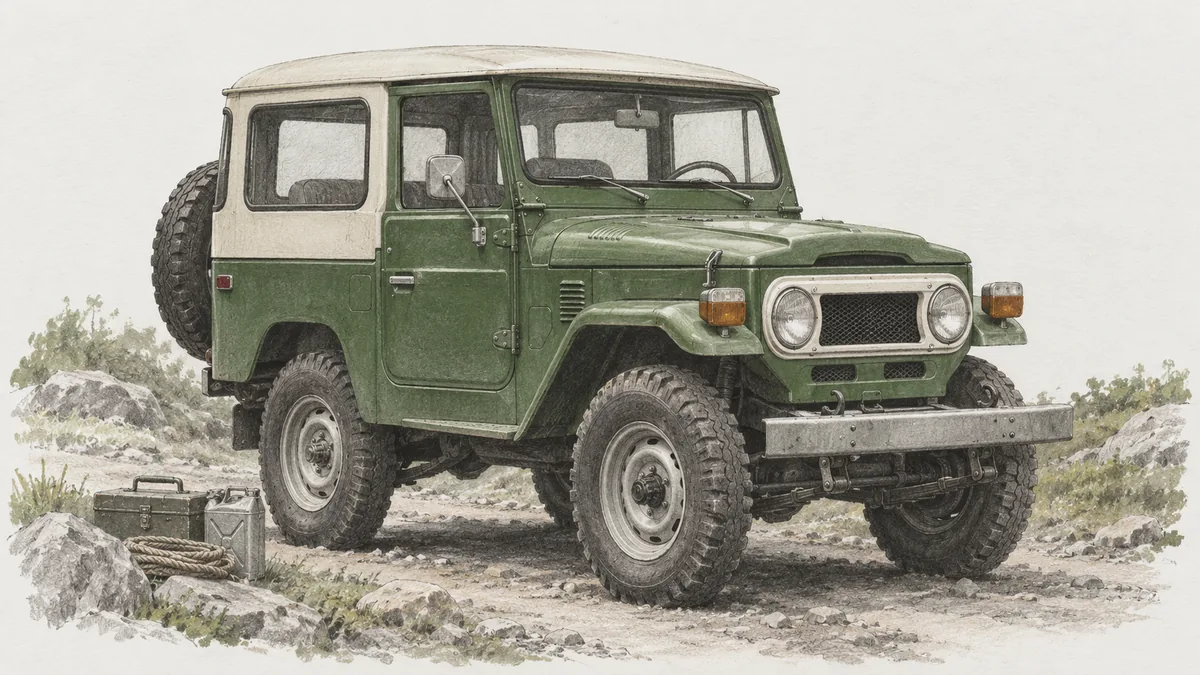
The Land Cruiser story begins with the Toyota BJ of 1951; the 40 series arrived in 1960. This is a family of working off-roaders with different bodies and engines, not one unchanging FJ40 for every market.
At the beginning, the BJ was not yet called Land Cruiser
The Toyota archive dates BJ development to 1951. The original project used a truck-derived platform and a six-cylinder petrol engine. The Land Cruiser name appeared in 1954: Jeep was another company’s trademark.
This sequence helps avoid a common oversimplification. BJ and Land Cruiser belong to one story, but the name and individual series did not appear at the same time.
What the 40 series brought
According to Toyota’s Heavy Duty history, the 40 series reached the market in August 1960. The family included different wheelbases and bodies, including vans, open versions and pickups. The engine range subsequently developed as well.
So the words “Land Cruiser 40” do not tell the whole story of a vehicle. A correct description needs its code, year, engine and market. The FJ40 is part of the family, not a universal name for every version.
Why its working brief shaped its image
For a utilitarian vehicle, ease of maintenance, suitability for its load and the ability to work far from familiar infrastructure matter. Editorially, these questions make a more interesting way to examine the Land Cruiser than a promise that it “never breaks down”.
A reputation for longevity develops through its history of use, but each vehicle remains a piece of machinery. It needs servicing and checks of fasteners, brakes, cooling and body condition. Age does not become harmless because of a famous badge.
Restoration and modern conversion
A surviving vehicle may have been restored close to factory condition or turned into a modern project. Both approaches have an audience, but they must not be confused when selling.
A new engine, gearbox, suspension or interior changes its character and operating requirements. Buyers need a full list of modifications and a clear history of work. An attractive body alone does not confirm the quality of the mechanical components.
Why the 40 series is interesting now
Against the backdrop of today’s complex SUVs, it helps explain the origins of the working off-roader. The purpose is not to declare an old design better than a new one, but to recognise different criteria for a good vehicle.
For KULT Stories, a strong narrative follows the development from BJ to the 40 series, then compares owners’ goals. One wants museum-level originality, another a leisure vehicle, a third a high-quality restomod. An honest description starts by identifying that objective.
Questions and answers
When did the Land Cruiser name appear?
Toyota gives June 1954; the original BJ was developed in 1951.
Are all 40-series vehicles identical FJ40s?
No. The family included different bodies, wheelbases, engines and model codes.