KULT Drive · Updated
Toyota Supra A80: where the factory car ends and the tuning legend begins
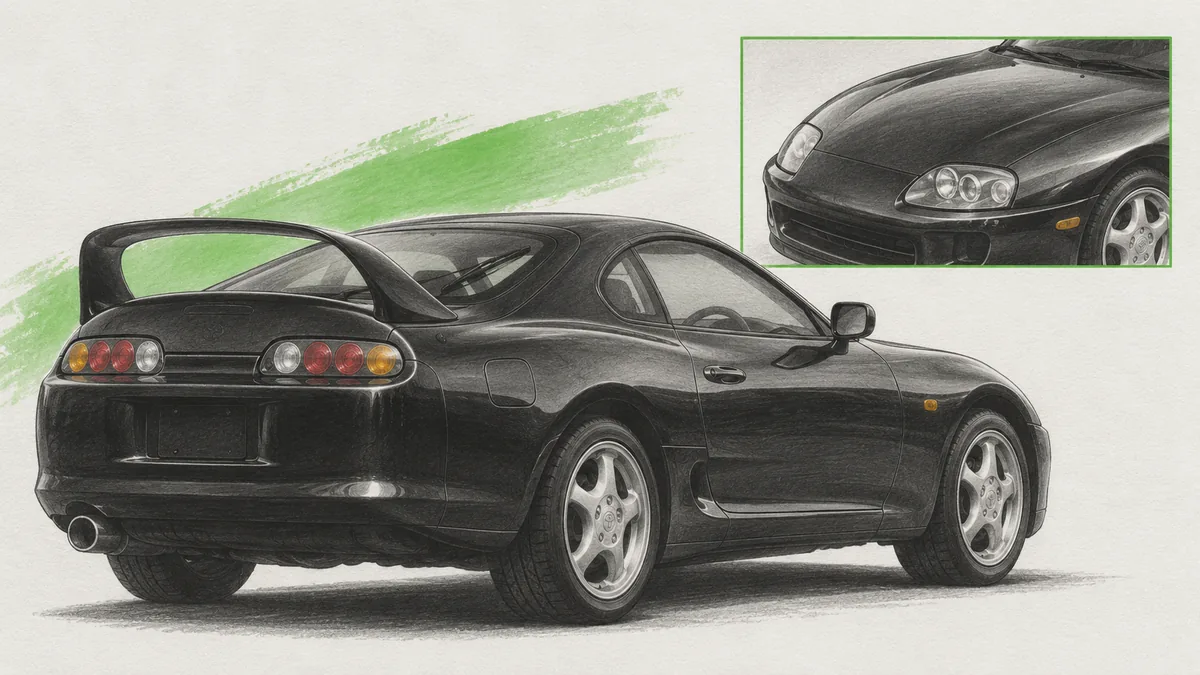
The Toyota Supra A80 arrived in 1993 in different versions, including the naturally aspirated 2JZ-GE and turbocharged 2JZ-GTE. The reputation of high-powered tuning projects does not mean every production car shared their engineering or performance.
First, establish which Supra is being discussed
The name’s history extends beyond one generation. Toyota UK traces its development from early Celica Supras to a sports car in its own right. The A80 is the fourth generation in the international chronology, but numbering can differ in some Japanese archive designations.
That is why the chassis code is often more useful than casually saying “second” or “fourth Supra”. It reduces the risk of discussing different cars under one generation number.
What the factory A80 offered
Toyota’s official entry dates the Japanese launch to 24 May 1993. The Japanese grades listed use three-litre straight-six 2JZ-GE and 2JZ-GTE engines, rated at 225 and 280 PS respectively.
Those numbers refer to specific Japanese specifications. They cannot serve as a universal description of all export cars, later versions and tuned examples. A naturally aspirated Supra does not become a factory twin-turbo simply by looking similar.
Why tuning changed perceptions of the model
Our editorial assessment: the A80 became a convenient symbol of a car whose capabilities seemed to lie beyond the factory specification table. But a project’s potential and the properties of a particular car are different things.
After replacement of the turbocharger, fuel system, gearbox or software, the buyer is dealing with the work of particular people. Documentation of changes, tuning quality, cooling, brakes and operating conditions all matter. A familiar engine name does not guarantee service life.
Which is more valuable: original or modified?
There is no universal answer. One owner values factory configuration; another wants a prepared sporting project. The mistake begins when the seller fails to disclose exactly what is being sold.
A comparison should consider the body’s origin, original specification, list of work and evidence of condition. Do not assess stated power alone: without measurement conditions and the complete configuration, it does little to explain the car.
Why the A80 story is useful today
It shows how owner culture can change the public image of a production model. But a good historical account must maintain the distinction between the factory, motorsport, cinema and private modifications.
For KULT Stories, a more interesting approach is to examine two cars: a documented, original A80 and an honestly described modified example. The story then becomes a tool for understanding, rather than another legend about an engine supposedly needing neither maintenance nor engineering calculations.
Questions and answers
Were all Supra A80s twin-turbocharged?
No. There were naturally aspirated 2JZ-GE and turbocharged 2JZ-GTE versions.
Does the 280 PS rating apply to every A80?
No. It refers to certain Japanese factory versions; other markets and modified cars require separate checking.