KULT Drive · Updated
BMW M1: the mid-engined BMW given a racing series of its own
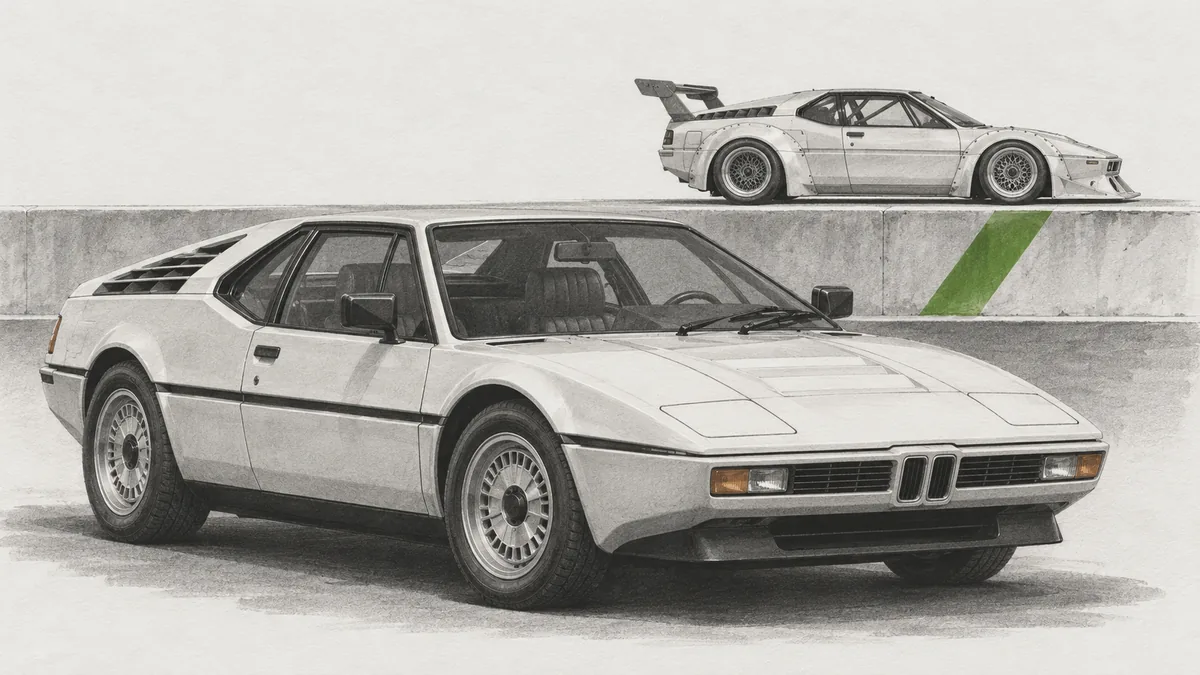
The BMW M1 debuted in 1978 as a mid-engined sports car. Difficulties preparing its racing programme led to the separate Procar series, where famous drivers and other racers competed in identical M1s.
Not an ordinary BMW with a more powerful engine
The M1 stands out through its layout alone. Its engine sits behind the cabin, and its low, wedge-shaped body differs from the brand’s familiar saloons. According to the BMW M archive, the car debuted in 1978, with a design by Giorgetto Giugiaro.
The road-going M1 had a 277 hp inline-six. That figure should not be confused with racing-version specifications. Even cars that look similar may have fundamentally different preparation and purposes.
Why the Procar series was needed
The original sporting plan encountered lengthy development and rule changes. A separate racing series became one response. BMW describes Procar as a 1979–1980 competition held alongside most European Formula One rounds.
Fast F1 drivers met privateers and other competitors in identical M1s. Niki Lauda won the first season, and Nelson Piquet the second. Bringing drivers together in similar machinery created an appeal of its own, independent of a factory team’s success in another championship.
The racing car is a separate story
For Procar, the car gained a wider body, a large rear wing and a race-prepared engine. BMW quotes around 470 hp for this version. Later projects under other regulations could differ even more.
A photograph of an M1 in racing colours therefore does not justify assigning it any maximum power figure found online. The series, year and individual car’s history are needed.
Why the M1 matters to the brand
Our editorial view: a rare project can sometimes shape a brand’s image more strongly than a mass-produced car. The M1 demonstrated BMW Motorsport’s ambitions in its own right and made it possible to see M as a separate engineering programme, not just an equipment specification.
The story also shows that an original plan can change without destroying the result’s value. Its own series turned delays and constraints into a different public story for the car.
What interests readers today
Against today’s complex electronic platforms, the M1 recalls a time when architecture and shape communicated a car’s purpose almost immediately. But the era need not be romanticised: a rare historic sports car requires specialist knowledge and care over originality.
For an article or video, a particularly strong approach is to place the road M1 beside a Procar. Explain their shared origins first, then show the differences. That works better than a collection of record figures without context.
Questions and answers
Was the BMW M1 mid-engined?
Yes. That is one of the defining features of the original 1978 M1.
What is Procar?
A separate 1979–1980 series for racing BMW M1s, whose competitors included Formula One drivers.