KULT Drive · Updated
Toyota 2000GT: the sports car that changed perceptions of Japan
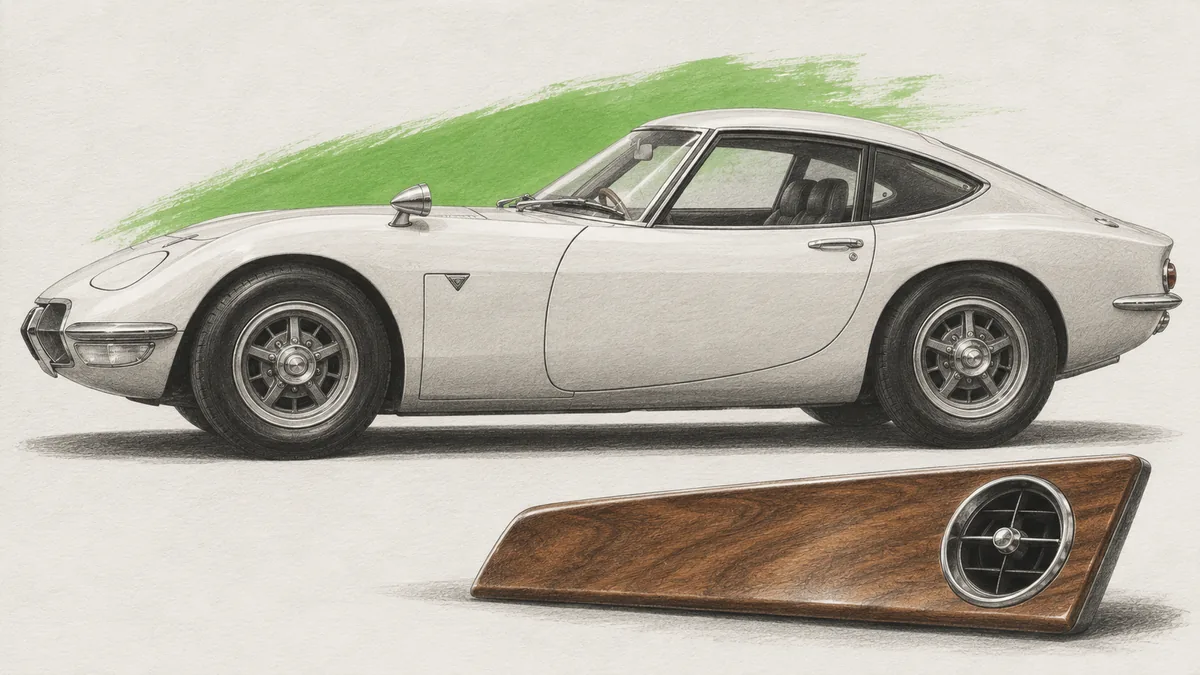
The Toyota 2000GT was conceived as a prestigious sporting GT to showcase Japanese automotive capability. Yamaha took part, while the famous open-top Bond film cars were special conversions, not a volume-production version.
Toyota needed a showcase car
In the mid-1960s, Toyota wanted to demonstrate not only its ability to build practical cars, but also its engineering standards. The 2000GT was intended to combine sporting ability with the qualities of a road-going Gran Turismo.
According to Toyota UK’s history, a prototype was built with Yamaha’s involvement in 1965 and shown at the Tokyo Motor Show. Japanese sales of the road car began in May 1967. Yamaha’s archive confirms the collaboration and helps avoid the oversimplification that Toyota merely put its badge on someone else’s finished product.
How the idea took shape
Toyota associates the design with Satoru Nozaki. The low coupé had a 2.0-litre inline-six engine, twin overhead camshafts and 150 bhp. Beneath the body was an X-shaped backbone frame.
The car’s purpose was not reducible to a single top-speed figure. Proportions, finish, manufacturing precision and the sense of a complete product mattered to the new prestigious image. This is an editorial interpretation of its role, not an invented account of a test drive.
Records before the production launch
Toyota used testing at Yatabe in 1966 to demonstrate the development’s capabilities. The manufacturer reports three world and thirteen international speed and endurance records over 72 hours.
Those results belong to a prepared test car under specific conditions. They do not mean every surviving 2000GT could repeat the same running today without preparation.
Why Bond’s car was open-topped
Two open-top versions based on prototypes were made for You Only Live Twice. A roofless car appearing in the film therefore does not prove the existence of a regular production-catalogue 2000GT roadster.
This is a useful example for any automotive history: a screen image, show prototype and production specification can differ. A photograph should always be connected to its origins.
What makes the 2000GT important
Our editorial conclusion: a low-volume project can change perceptions of an entire industry. Sometimes a flagship’s role is not mass sales, but demonstrating what a manufacturer can achieve.
Today, the 2000GT is interesting to compare with Japanese sports cars from other eras, not to create a power ranking, but to see how objectives evolved. From proving engineering maturity to new ideas of accessibility, ease of use and technology.
Questions and answers
Who helped create the Toyota 2000GT?
Toyota developed it jointly with Yamaha, whose role included technical collaboration and low-volume vehicle manufacture.
Was there a mass-produced 2000GT roadster?
No. The famous open-top Bond film cars were special prototype versions.